
For decades, the x86® architecture has dominated the computing landscape. Its influence has reached across a wide range of applications—from personal computers and enterprise servers to graphics workstations and scientific environments. This CISC-based architecture has long offered considerable raw computational power. However, persistent challenges have remained, notably in energy efficiency, thermal scalability, and modular adaptation.
 In parallel, ARM®, grounded in RISC
(Reduced Instruction Set Computer) principles, has built a reputation for
modularity, efficiency, and flexibility. Initially restricted to mobile and
embedded systems, ARM® has evolved through a progressive development of its
ecosystem. Today, it is an industrially viable alternative across multiple
critical segments.
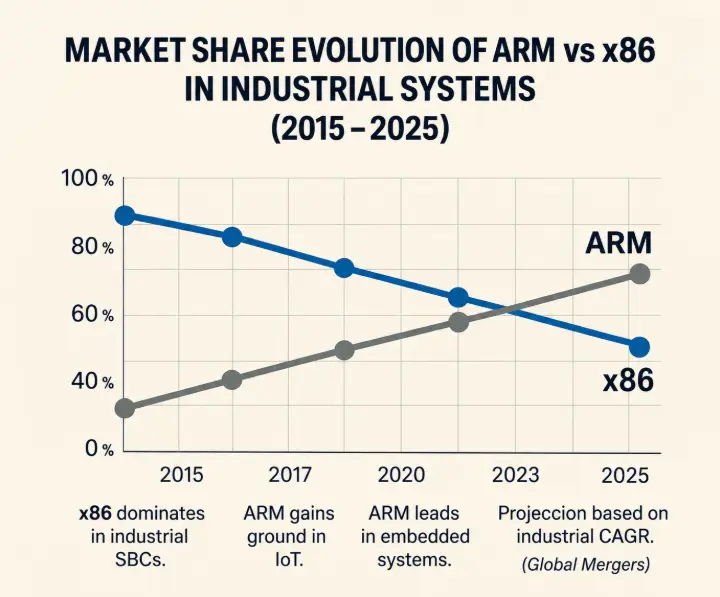
A key inflection point came in November 2020, when Apple® announced its transition to ARM® processors for its Mac® devices. According to ABI Research®, ARM® is expected to reach a 13% share of the global PC market by 2025. Even more significant, TechInsights® reported in October 2024 that ARM® could account for as much as 52% of global laptop revenue by 2029. These figures reflect not only commercial evolution but also the leveraging of economies of scale. Mass-market adoption has accelerated technology maturity, lowering unit costs and standardizing supply chains.
For electronic engineers, this shift has deep implications. The widespread adoption of ARM® in smartphones, tablets, and laptops has enabled more efficient manufacturing processes, cost reduction per unit, and the creation of a robust ecosystem of compatible components. Proven solutions in millions of consumer devices can quickly be adapted to industrial environments: autonomous sensors, gateways, connected machinery, and embedded systems all benefit from this foundational evolution.
In the industrial sector, ARM® is now not just viable but dominant. According to a February 2024 report from WiseGuy Reports® titled “Industrial Single Board Computer Market”, the global industrial SBC market is projected to grow from USD 3.53 billion in 2024 to USD 11.33 billion by 2032, with a compound annual growth rate (CAGR) of 15.7%. ARM® holds between 60% and 70% market share in this segment. This architecture offers compact, fanless, energy-efficient solutions, easily integrated into environments with strict thermal and spatial constraints.
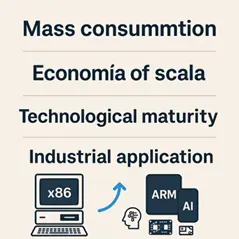
In critical areas such as manufacturing systems, automation, collaborative robotics, and distributed control, ARM® has shown its adaptability and reliability. In contrast, x86®—despite its raw performance—faces structural challenges operating continuously in hostile environments or with limited power supply.
Another key area is Edge Computing, especially for distributed artificial intelligence applications. In 2023, Markets and Markets® highlighted that ARM® held a majority hardware position in Edge AI, a market projected to reach USD 59 billion by 2030, with a CAGR of 17.6% from 2025 to 2030. ARM®’s multicore design and its ability to integrate NPUs (Neural Processing Units) make it possible to implement efficient local inference in industrial systems. Direct applications include machine vision on production lines, predictive maintenance, and real-time vibration analysis.
 Energy efficiency has become a
strategic criterion beyond simple electricity consumption. ARM® simplifies
cooling systems, reduces reliance on mechanical components, and increases
reliability under adverse environmental conditions. In applications such as
precision agriculture, remote mining operations, ports, or regions with
unstable connectivity, ARM® has proven to be not only more feasible but also
more sustainable over the long term.
Even in industrial server environments, where x86® has traditionally been the standard, ARM® is making inroads. In April 2024, The Wall Street Journal® reported that Amazon® now uses custom ARM® chips (AWS Graviton / AWS Trainium) in over 50% of its new data center CPUs. This marks a quiet transition to more efficient architectures even in critical infrastructure, suggesting that ARM®’s consolidation extends beyond edge or IoT applications, scaling up to the industrial cloud.
With this context, ARM® ceases to be just a promising alternative and becomes the emerging standard for demanding professional applications. Its success in the consumer market has driven the development of solutions applicable to industrial contexts, and it now directly competes for leadership in fields traditionally reserved for x86®.
Looking ahead, it is important to monitor the role of RISC-V®. In recent years, China has started to promote this open architecture as a tool for technological sovereignty. In December 2023, Xataka® reported that companies like Alibaba® are developing RISC-V® processors to replace proprietary architectures, especially focusing on the industrial and educational sectors. This phenomenon will be explored in detail in an upcoming article.